Choose a stage laser light manufacturer by verifying five things in order: measured output, certification paperwork, IP rating for the venue, control compatibility and lead time in writing.
3 W–60 W RGB covers most club and touring work.
Demand a test report and live demo, not catalogue figures.
Match IP54, IP55 or IP65 to the site, not the price list.
Most sourcing problems in this industry are not hardware failures. They are mismatches agreed on paper months earlier: a 10 W head specified for a 60 m throw, an IP20 housing booked for an open-air festival, a control protocol nobody checked against the console already on site. By the time the freight lands, none of it is negotiable.
This guide is written for distributors, club and theatre contractors, lighting designers and rental companies who buy laser systems in volume. It walks through the checks that separate a factory from a reseller, using the same order of questioning our engineers use when a project brief arrives at DarkTone, a stage laser light manufacturer based in Guangzhou.
What Actually Decides Whether a Laser Supplier Can Deliver Your Project?
Four capabilities decide it, and none of them appear on a price list: whether the supplier owns the production line, whether they can document the output they ship, whether they can hold a delivery date, and whether anyone answers a technical question after the invoice clears.
A trading company can usually match a factory on the first quotation. What it cannot match is the information that follows — the diode batch actually used, the scanner model, the driver board revision, the reason a unit failed in month seven. For a single bar install that gap is survivable. Across a 40-unit club rollout or a festival season, it becomes the project's biggest risk.
The practical test is simple. Ask for the factory address, then ask a technical question that only production staff can answer, such as which diode bin the 20 W RGB head currently ships with. A reseller forwards the question; a manufacturer answers it.
Outdoor work exposes power, housing and cooling decisions that a dark club interior hides.
Why the venue scale question comes before the brand question
A 60 m throw across a festival field and a 12 m throw across a nightclub floor are two different engineering problems, and the same fixture cannot be optimal for both. Deciding the venue type first narrows the supplier list to factories that actually build for that duty cycle.
This is also where the conversation usually moves from catalogue browsing to laser lights by application family, because throw distance and ambient light — not enclosure size — drive the specification.
Power, Colour and Scanner Specs: What the Numbers Must Match
Wattage alone tells you very little. What matters is the combination of output power, beam divergence, scanner speed and the ambient light the beam has to survive. A 20 W unit with 0.8 mrad divergence reads sharper at 50 m than a 30 W unit with 2 mrad spread, because the beam arrives tighter rather than merely brighter.
Colour matters just as much in practice. Full-colour RGB systems built on 638 nm red, 520 nm green and 450 nm blue give the saturated mixes that rental clients expect; single-colour heads are cheaper but limit you to one visual idea per fixture. Our 3 W–60 W range is RGB across the board for exactly this reason.
Typical planning ranges for RGB stage laser output against throw and ambient light
Output class
Typical throw
Ambient conditions
Usual application
Scanner
3 W – 5 W
10 – 20 m
Dark room, light haze
Bars, private events, small clubs
25k pps
10 W
20 – 40 m
Club lighting with haze
Nightclub main floor, theatre
30k pps
20 W
40 – 60 m
Medium stage wash light
Concert halls, mid-size touring
30k – 45k pps
40 W
60 – 100 m
Outdoor with city light pollution
Festivals, large venues
45k pps
60 W
100 – 150 m
Open field, strong ambient light
Stadium-scale shows, landmarks
45k pps
Treat the table as a starting point for a specification conversation, not a guarantee. Haze density, humidity and the number of beams you plan to project all shift the answer by a full power class in either direction. The honest supplier will ask about all three before quoting.
Scanner speed deserves a separate question. A 25k pps scanner handles beam shows and simple graphics; 45k pps is where complex ILDA animation stops looking stepped. If your show file contains detailed logos or text, the scanner spec is the one that will disappoint you first.
Which IP Rating Does Your Venue Actually Need?
IP rating is a site decision, not an upsell. Buying IP65 for an indoor booth wastes money on a heavier housing; buying IP54 for a rainy festival costs you a season of shows. Match the housing to where the fixture will physically live for the next five years.
IP rating against venue type, mounting position and maintenance reality
Rating
Protection
Fits
Watch out for
Maintenance
IP54
Dust protected, splash resistant
Clubs, theatres, indoor venues with occasional cleaning spray
Not for rain, not for dust-heavy outdoor rigs
Internal cleaning required
IP55
Dust protected, water jets
Covered outdoor stages, terrace venues, touring between indoor and outdoor dates
Heavier housing, verify salt-spray and thermal testing
Gasket replacement schedule
Two details decide whether the rating holds up in year three. The first is the gasket material and how the housing seals around the aperture; the second is thermal design, because a sealed box that cannot shed heat will fail long before water gets in.
For club work, IP54 on a club laser light is normally enough — the fixture never sees rain and the priority is a compact housing and quiet cooling. For festival and touring inventory, the outdoor shows laser light range is where IP65 and thermal headroom matter more than a few thousand lumens.
Ask for the test, not the label
Any factory can print IP65 on a spec sheet. Ask what was actually tested and how: water jet duration, spray angle, enclosure sealing method, and whether the sample tested was a production unit or a hand-built prototype.
If the answer is vague, treat the rating as marketing. A supplier who has genuinely tested will have photographs, a test date and a model number attached to it.
Housing, cooling and optics decide whether the same output survives a full season.
How Do You Verify Real Output Before You Pay?
Verify it three ways, in increasing cost but decreasing risk: a test report with the serial number, a live video call at the factory with the unit running, and a sample delivered to your own venue. Skipping all three is how buyers end up with 12 W of measured output on a unit sold as 20 W.
A credible test report shows measured power at the aperture, not at the diode. The difference between diode power and delivered optical power is where most of the industry's optimism lives, and it is routinely 15–25 %.
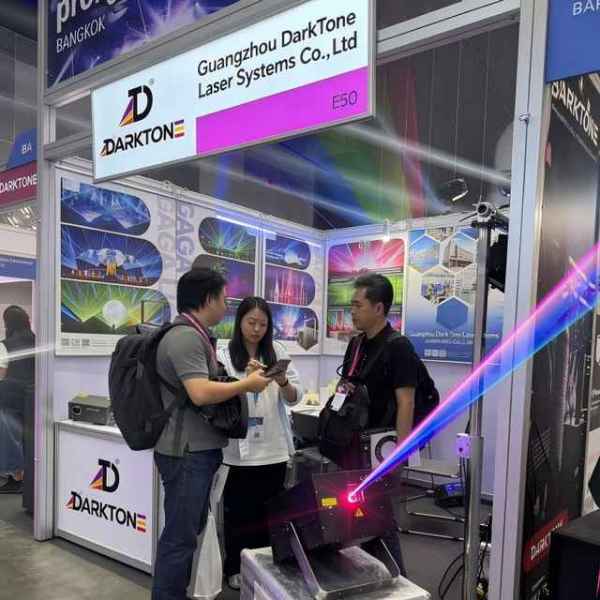
Live demonstrations close the remaining gap. Watching a unit run for 30 minutes tells you about thermal drift, fan noise and colour balance stability — none of which a datasheet records. This is why we run continuous demos at trade shows and invite buyers to the Guangzhou line rather than sending renders.
Certifications That Clear Customs, and the Ones Sellers Invent
Laser products sit in a regulated category, so paperwork is part of the product. For the European market, CE marking and RoHS compliance are the baseline. For the United States, an FDA/CDRH accession number tied to a product report is the document customs and inspectors actually look for, and a variance held by the wrong party does not protect your shipment.
Laser safety classification follows IEC/EN 60825-1, and any manufacturer quoting a class for a show laser should be able to point to the calculation behind it. Class 3B is the normal category for professional show equipment; the practical question is what the manufacturer provides alongside it — key switch, emission delay, remote interlock and warning labels.
Testing data is where claims become unfalsifiable. If a supplier quotes a specific pass rate, an irradiance figure or a test lab report number, ask to see the document with your model number on it. We publish what we can verify — CE, RoHS, FCC and FDA variance documentation — and flag anything model-specific for confirmation rather than filling the gap with a number.
OEM/ODM: What a Real Factory Can Change, and What It Cannot
A factory with its own line can change housing colour, logo, laser engraving, packaging, firmware defaults, DMX channel mapping and even the diode mix within limits. It cannot change physics: you will not get 40 W out of a 20 W thermal design by asking, and a housing rated IP54 will not become IP65 through a sticker.
Ask for the boundary explicitly. Good OEM conversations start with what the platform already supports and where a new tooling cost begins, because that answer determines whether your customisation is a 15-day change or a 60-day project. Factory-direct sourcing for large projects is worth reading before you commit to a bespoke housing.
A live demo answers thermal and colour questions that a catalogue cannot.
What to send with an OEM enquiry
Send the venue type, throw distance, number of units, control platform, target IP rating and any branding requirement in one message. Suppliers who can quote from that brief within 48 hours are usually working from a real production schedule.
Vague enquiries attract optimistic quotes, and optimistic quotes are the ones that slip.
Lead Time, MOQ and the Production Calendar Nobody Shows You
Ask for lead time in writing, split into three numbers: sample build, production run, and shipping transit. A single "30 days" answer usually hides a 15-day production window plus two weeks of queue.
For standard RGB models, a realistic production window at a factory running its own line is 15–30 days depending on quantity and housing type, with samples typically 7–10 days. Custom housings, non-standard diode mixes and private-label packaging add tooling and validation time on top.
MOQ is the other number that changes the deal. Many factories will ship one to three units as a paid sample; volume pricing usually starts at 10–20 units per model. Get both figures before you design a tender around a price that only exists at 100 units.
Control Ecosystem: DMX512, ILDA and Pangolin BEYOND Compatibility
Control is where installations fail quietly. A fixture that speaks DMX512 but not Art-Net cannot join a networked rig without extra hardware, and a laser that will not accept an ILDA feed cannot be programmed from the software your designer already owns.
Confirm compatibility against the actual console and software in use: DMX512 for channel-based control, Art-Net where the rig is networked, ILDA for direct show playback. Pangolin BEYOND compatibility matters specifically for designers running advanced timeline work, and it is worth testing with your own show file rather than a factory demo file.
Ask one extra question: how many DMX channels does the fixture consume in the modes you plan to use? A 30-channel laser across 24 fixtures eats 720 channels, which quietly decides your console size.
Factory-Direct or Trading Company? Where the Margin Actually Goes
Both models can work; they fail differently. A trading company bundles several factories and can quote a mixed order quickly, but it does not control the production schedule it promises. A factory controls the line, the test bench and the spare parts inventory, which is exactly what a multi-year project depends on.
The distinction shows up in after-sales. When a scanner fails in month eight, the factory can ship a replacement board from stock; the trader has to ask someone else. Ask what spare parts are held in stock and what the standard replacement lead time is — the answer tells you which model you are actually buying from.
DarkTone, a stage laser light manufacturer running its own line in Guangzhou, sits on the factory side of that line. That changes what can be promised: production dates belong to us, and so do the answers when a unit misbehaves in the field.
What Happens After Delivery
Delivery is the midpoint, not the end. The questions that matter afterwards are warranty length, what it covers, how a failure is diagnosed remotely, and whether spare diodes, scanners and driver boards are available for the model you bought three years ago.
Our standard position is a two-year warranty with lifetime technical support, and we keep consumable parts for current models. Confirm the equivalent terms in writing with any supplier — including whether the warranty covers diode degradation, which is the most common long-term failure and the one most often excluded.
A 10-Point Scorecard for Shortlisting Suppliers
Score each candidate out of ten and drop anyone below six before you discuss price. The scorecard is deliberately boring; the failures it catches are not.
01
Owns the production line
Factory address, line visit or video walkthrough available on request.
02
Documents real output
Measured power at the aperture, tied to your model and serial range.
03
Certification paperwork
CE, RoHS, FCC and FDA variance documents with the model number visible.
04
IP rating evidence
Test method, sample type and date — not a label alone.
05
Control compatibility
Verified against your console, software version and channel budget.
06
Lead time in writing
Sample, production and transit quoted as three separate numbers.
07
OEM boundary clarity
Clear statement of what is configurable and where tooling cost starts.
08
Spare parts policy
Stocked boards, scanners and diodes with a stated replacement lead time.
09
Warranty scope
Written terms including whether diode degradation is covered.
10
Technical response
A named engineer who answers within one working day during the project.
Frequently Asked Questions
How much power do I need for a 50 m throw?
Plan for roughly 20 W of RGB output at 50 m in a hazed club or theatre, and move to 40 W if the beam must survive outdoor ambient light or city glow. Divergence matters as much as wattage: a tighter beam at lower power often reads better than a wide beam at higher power.
Is IP65 necessary for an outdoor festival?
Yes for open-air sites. IP65 protects against dust ingress and water jets from any direction, which is the minimum for fixtures that stay rigged through rain and dust. Covered stages can usually run IP55, but check gasket condition before every season rather than assuming the rating is permanent.
What certifications should a stage laser manufacturer provide?
CE and RoHS for Europe, FCC for electromagnetic compliance, and an FDA/CDRH accession number with a product report for the United States. Ask for documents carrying your exact model number, and confirm the safety classification basis under IEC/EN 60825-1 rather than accepting a class printed in a brochure.
How long does production take for a custom order?
Standard RGB models typically run 15–30 days in production, with samples around 7–10 days. Custom housings, private-label packaging or non-standard diode configurations add tooling and validation time. Always get sample, production and transit quoted separately so a delay can be traced to the right stage.
Can I get one sample before placing a volume order?
Most factories will ship one to three paid samples, though volume pricing usually begins at 10–20 units per model. Use the sample to test thermal drift over 30 minutes, colour balance and control compatibility with your own console — the three things a catalogue cannot demonstrate.
Where can I read more answers about laser systems?
Our full FAQ library covers certification, IP ratings, control setup and spare parts in more depth than this guide can. Browse the DarkTone FAQ page for the complete list, and if your question is still not covered, send it with your show spec and we will answer it directly.
Tell Us Your Show Spec
If you are shortlisting suppliers now, the fastest way to compare is to send the same brief to each one. Include venue type, throw distance, unit count, control platform, target IP rating, branding requirements and your delivery window.
Send that brief to DarkTone, a stage laser light manufacturer building 3 W–60 W RGB systems in-house, and we will come back with a model match, the IP rating options for your site, and a lead time broken into three numbers. No catalogue dump, no invented test data — if a figure is not yet confirmed for your configuration, we will say so and confirm it before you commit.
With 16 years of laser lighting expertise, we deliver one-stop design, programming, commissioning & compliance for shows, cultural tourism and events. Reliable laser visuals, risk-controlled, efficient, for iconic lighting highlights.