IP Ratings for Stage Lights: Indoor, Semi-Outdoor and Outdoor Sealing Plans for Eight Fixture Types
Oct 23,2026
An IP rating is not a badge on a spec sheet — it is a statement about which joints survive which weather. This guide is for the people who sign off on the rig: rental managers, integrators writing a tender, and designers who need a defensible number instead of "waterproof".
Quick Answer
Match sealing to exposure, not to a marketing badge: indoor rigs need IP54, covered stages IP55, open-air stages IP65.
Judge a fixture by its weakest joint: pan/tilt axis, cable gland or hatch gasket.
Plan 3W–60W stage lasers for 20–200 m indoor throws.
Plan 120W–300W units for 150–300 m outdoor throws.
What Does an IP Rating Actually Protect on a Stage Light?
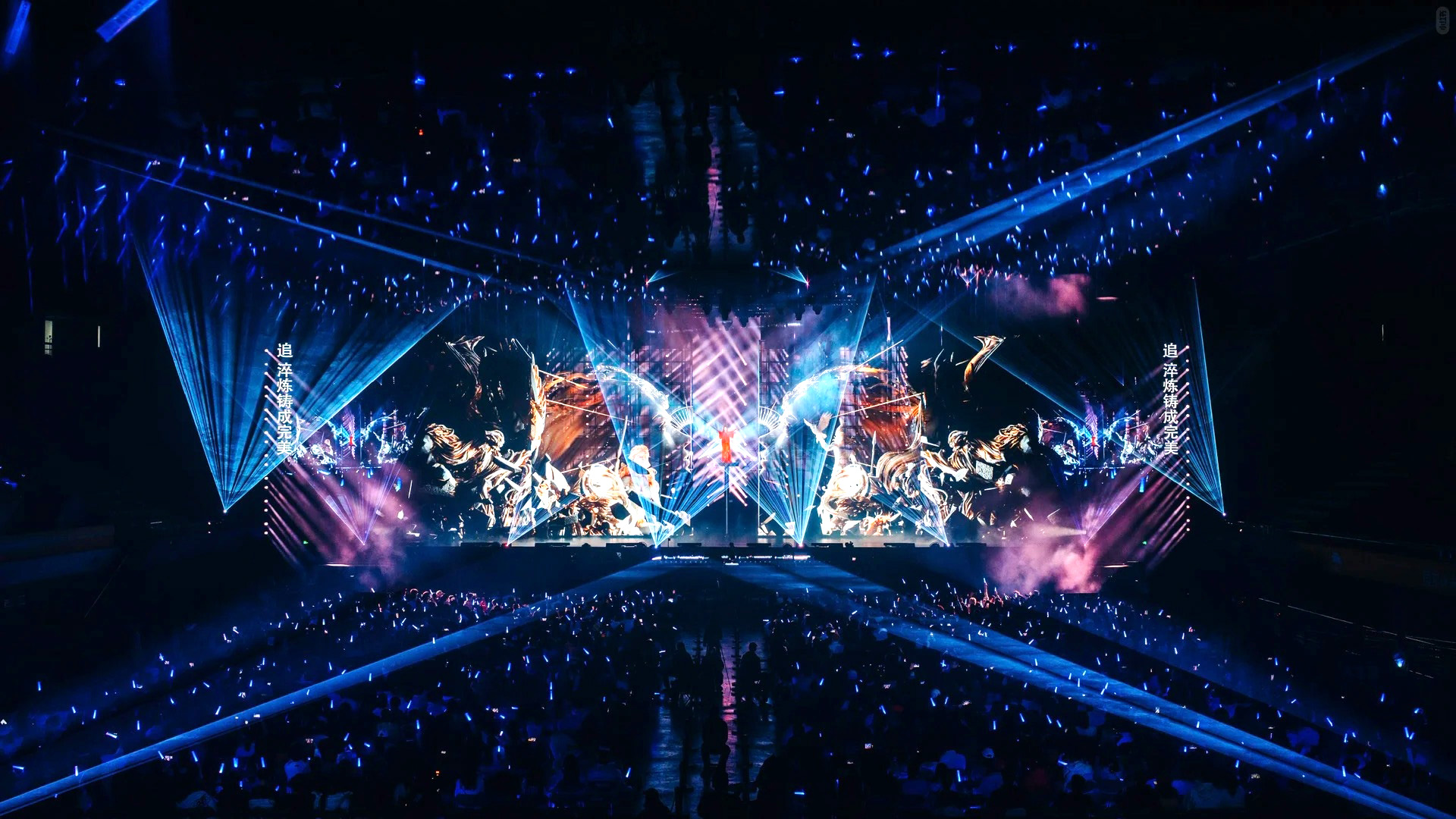
A touring position after dark: the beams are the visible half of the job.
An IP number has two digits and no hidden meaning. The first covers solids (0–6), the second covers water (0–9K), so IP54 means dust-protected and splash-resistant while IP65 means dust-tight and jet-proof against 6.3 mm water jets at 12.5 L/min from 3 m for 3 minutes under IEC 60529.
A 200W par light and a 300W laser projector can both claim IP65 and still behave differently after 40 shows, because the rating describes a lab pass, not a service life. Indoor venues rarely kill fixtures with dust — they kill them with condensation from 80% humidity and 15 °C overnight swings. That is why a splash-rated body with a correctly placed breather valve outlasts a "sealed" body with no pressure equalisation.
What Separates Indoor, Semi-Outdoor and Outdoor Duty?
Three condition bands cover almost every stage lighting brief, and each one stresses a different part of the fixture.
Indoor duty
18–30 °C, 40–60% relative humidity, low airborne dust and a 6–8 hour show window. Dust is a slow optical problem here; condensation from air conditioning is the fast one.
Semi-outdoor duty
A roofed stage, tent or arena dock: rain arrives at 45° with wind, humidity sits above 80% for weeks, and fixtures bake at 40 °C by day then drop to 12 °C at night. This is the band where a warm housing cools and pulls moisture inward.
Outdoor duty
50 mm/h rain and above, UV exposure, coastal salt spray and 12–16 hour festival cycles. Water no longer needs wind to reach the fixture — it arrives from every direction, including splash-back off the stage deck.
That middle category is where budgets go wrong: specifying IP20 units to save 15–20% per fixture loses the difference in the first rainy week, because water only has to reach a warm housing that then cools.
IP Class, Fixture Type and Deployment Scenario
Table 1 — IP class versus fixture type and deployment scenario.
Power, Throw Distance and Sealing: How the Numbers Scale
More power means more heat, and heat is the enemy of every gasket. A 3W RGB laser can live in a thin aluminium box; a 300W projector needs forced air, large heat sinks and a body rigid enough that thermal expansion never unseats its door seal. Across LED fixtures the same rule runs from a forgiving 200W par to a 1500W moving profile.
Table 2 — Power and planning throw versus recommended IP by condition.
Fixture
Power
Planning throw
IP by condition
Control
Stage laser light, indoor
3W–20W RGB
20–100 m
IP54 indoor / IP55 covered
DMX512, ILDA, BEYOND
Stage laser light, outdoor
30W–300W RGB
100–300 m
IP65 open / IP66 coastal
DMX512, ILDA, FB4
Moving head, beam/wash
150W–450W LED
15–60 m
IP20–IP54 indoor / IP65 out
DMX512, RDM, 16-bit
Moving head, profile
625W–1500W LED
25–80 m
IP65 framing
DMX512, RDM, CMY+CTO
Par light
120W–200W
8–25 m
IP20 indoor / IP65 outdoor
DMX512, 8CH, sound
Wall washer
200W–720W
10–40 m facade
IP65 / IP66 exposed
DMX512, 4–8CH
Strobe
960–1500 LEDs
15–35 m
IP20 indoor / IP65 outdoor
DMX512, 8/17/101CH
Fog / haze
600W–4000W
10–20 m spray; 10–13 m jet
IP20 indoor / IP55 outdoor
DMX512, remote
Kinetic lifting
9CH–60CH
5–30 m travel
IP20 indoor / IP54 covered
DMX512, MADRIX
These throw figures are planning ranges, not photometric data. Request measured beam angle, divergence and illuminance at your trim height before you commit a design.
Stage Laser Light: Output, Scanner Speed and IP Class
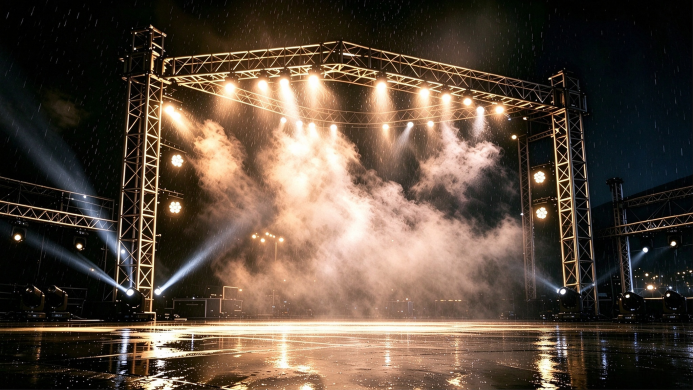
A main-stage position after dark: sealed fixtures sit behind the beams, not in front of them.
A stage laser light is an effects fixture: it throws beams, fans, sheets and graphics through the air above the stage. Output is quoted in optical watts — 3W to 60W RGB as standard, with 120W and 300W units for large outdoor positions — using 638 nm red, 520 nm green and 450 nm blue modules, a 30k–45k pps scanner and a scan angle up to 60°. Control is DMX512, ILDA or Pangolin BEYOND.
Indoor positions run 3W–20W at IP54 for 20–100 m throws, where a compressed silicone gasket and a sealed cable entry are enough. Covered stages move to IP55 for the 10W–60W class, which tolerates 80% humidity and wind-driven splash. Open-air rigs need IP65 at 30W–300W for 100–300 m throws, and coastal sites within 500 m of salt water justify IP66 with stainless fasteners and salt-spray evidence.
Two safety rules travel with every unit. Anything above 5 mW is Class 3B and above 500 mW is Class 4 under EN 60825-1, so interlocks, key switches and emission delays must survive the sealing work; and any scanning effect that can reach the audience needs a valid FDA/CDRH variance under 21 CFR 1040.11(c) for the US market.
Laser Projection: Brightness, Resolution and Throw Ratio
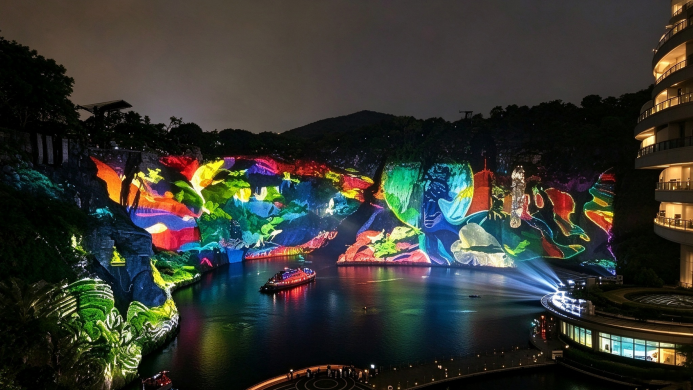
A large outdoor show position: every weather-facing surface here is a sealing decision.
Laser projection puts a finished image on a surface: screen, facade, water screen or floor. Units are specified in lumens and resolution — 3,200 lm, 6,500 lm and 20,000 lm classes, WUXGA 1920×1200 panels, 3LCD optical engines, throw ratios from 0.44:1 short throw to long throw, 120–240 V input drawing up to 1,520 W, and a light source rated 20,000–30,000 hours.
Table 3 — Projection classes by brightness, resolution and throw.
Class
Brightness
Resolution
Throw
Typical deployment
Indoor interactive
3,200 lm
WUXGA
Long throw
Museum, showroom, training room
Short-throw interactive
6,500 lm
WUXGA
0.44:1
Wall and floor projection in tight rooms
Large-venue
20,000 lm
1920×1200
Long throw
Facade, arena, water screen
Sealing works differently here, because the projector is usually a chassis inside a second enclosure. The chassis carries a low IP number, so weather protection comes from the housing: an optical window at the lens, a filtered intake and exhaust that keeps the heat path separate, a lens heater for 90% humidity nights, and a service hatch you can open without disturbing the glass. For a facade or water-screen position, specify the combined assembly as IP65 and ask for the window cleaning interval in writing.
Installation is set by geometry. Throw ratio decides the distance for a given image width — a 0.44:1 lens fills a 4 m wall from 1.8 m, while a long-throw lens needs 8–12 m. Check ambient light at show time, keep the exhaust clear by at least 500 mm, and confirm lens shift before you fix the bracket.
Moving Head Light: The Pan/Tilt Axis Decides Your IP Number
A moving head puts a rotating joint in the middle of its water path, so the pan/tilt bearing is the first place an IP65 claim gets tested. Indoor units at 150W–450W LED commonly run IP20–IP54 with 540° pan and 270° tilt, which is fine for a 25 °C theatre at 50% humidity.
Semi-outdoor duty needs a labyrinth seal around the yoke plus a positive-pressure path, so the 40 °C day / 12 °C night cycle does not pull moist air into the head. Most "IP54" touring heads fail here not because water enters, but because condensation forms on the dichroic filters and never leaves.
Outdoor heads should be IP65 minimum: 371W beam units in die-cast aluminium rated IP65–IP66, 625W five-head tornado fixtures, and 1500W framing profiles with CMY + CTO and 5°–50° zoom. Expect 20–35% more weight and a slower service routine, since every access panel now has a gasket you must reseat. Compare the moving head range with the outdoor wash group.
Par Light: Cheap to Replace, Still Worth Sealing Properly
Par lights are bought by the hundred, so sealing decisions get made on price — usually a mistake at the 200W class. An 18×18W 6-in-1 IP65 par costs perhaps 12–18% more than its indoor twin, yet survives a festival season instead of one rainy weekend. Indoor duty (IP20–IP54) covers 18×4-in-1 200W units at 8–25 m in clubs, theatres and conference rooms.
Semi-outdoor duty justifies IP65 with sealed DMX in/out and a gasketed lens frame, because par lights sit low on the truss where splash reaches them. Outdoor duty is IP65 by default, with downward cable entries and a drip loop on every lead. Browse par lights or the outdoor par light group.
Gobo Light: Sealing an Optical Path That Must Stay Clean
A gobo light fails optically long before it fails electrically. Half a millimetre of dust on a gobo wheel costs 10–15% of output and turns a sharp pattern into a grey smear, so filtration is a sealing question. Indoor 150W–300W units with 8-prism effects and 16–25 DMX channels are fine at IP20–IP54 when the fan path carries a replaceable filter.
Semi-outdoor and outdoor gobo work should be IP65 with a sealed optical chamber and a separate cooling path, so air reaching the LED never crosses the gobo wheel. The 1500W IP65 moving profile with CMY + CTO, 4-blade cutter and 5°–50° zoom is the standard outdoor answer at 25–80 m. See the gobo light page.
Strobe Light: High Voltage, Fast Discharge, Harder Sealing
Strobes combine high-voltage discharge with 1–30 Hz flashing, and each cycle expands the housing slightly — a slow pump that pushes moist air through any imperfect seal. Indoor 960-LED and 1500-LED arrays at 8/17/101 DMX channels with flicker-free dimming are comfortable at IP20–IP54 on a 15–35 m throw.
Covered stages need IP55 with a sealed driver compartment; open-air rigs need IP65 with potted driver boards and a drainage channel below the lens. Never accept "water-resistant" as a substitute for a number on the datasheet. Start from the strobe light page or the outdoor waterproof strobe group.
Wall Washer Light: The Fixture That Lives Outdoors by Default
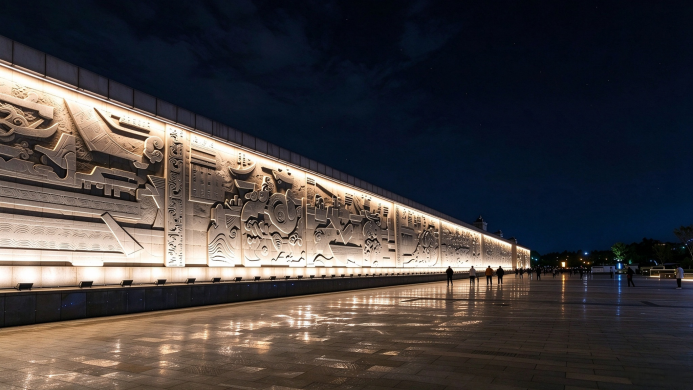
Facade and landmark work is outdoor work by definition: jet-proof housings and downward cable exits.
Wall washers are specified for facades, bridges and building edges, which makes them outdoor fixtures even when a brief calls them architectural. A 200W IP65 unit suits a 10–40 m facade; a 72×10W city colour bar with a 45° beam covers larger elevations.
Service life is decided by the bracket and cable exit rather than the front glass: water runs down the bracket, pools at the gland and wicks into the driver. Specify a downward-exiting gland, a drip loop, and IP66 where the fixture is fully exposed or within 500 m of the coast. Review the wall washer light page.
Special Effects Machine: Why IP65 Rarely Applies the Way You Expect
Effects machines handle fluids, so their IP logic diverges from lighting. A flame projector is typically rated IPX3 — spray-resistant, not dust-tight — because the housing must vent, drain and shield rather than seal, and the real risks are fuel residue and ignition control rather than rain ingress.
Fog and haze sit in another bracket: 600W–3000W units with 6–10 L tanks and 20 m spray distance are indoor IP20 products, while a 2800W haze machine at IP55 or a 3400W jet fogger at IP55 with 10–13 m jet height works under a roof but not in open rain. Semi-outdoor is the ceiling for most fluid effects: specify IP55, keep the tank covered, and allow a 20–30 minute purge before transport. See special effects machines.
Kinetic Lifting Light: Sealing a Fixture That Travels on a Cable
Kinetic fixtures add a moving cable and a winch to the sealing problem, and the cable itself is a water path. Indoor kinetic tubes, spheres and lifting footballs at 9CH–60CH on DMX512 or MADRIX are normally IP20, which is correct for clubs and theatres with 5–30 m travel and dry air.
Covered stages can reach IP54 by sealing the winch enclosure and using a hydrophobic-core cable, but the entry must still breathe or the enclosure draws water in on every cooling cycle. Outdoor kinetic work should be engineered per project — treat IP65 as a custom brief, not a catalogue option. Browse the kinetic lifting light page and discuss rigging through the contact page.
Which Sealing Details Fail First?
Four components cause most ingress, and none of them is the housing shell. First the cable gland: an M20 gland torqued to the wrong value, or a cable pulled sideways, leaks within weeks. Second the hatch gasket: silicone compresses 20–30%, then takes a permanent set, so a hatch opened 40 times a season stops sealing.
Third the breather valve: a blocked valve turns a sealed body into a condensation chamber, and a 15 °C night swing is enough to deposit water on a cold lens. Fourth the fasteners: zinc-plated screws at a coastal venue corrode, loosen and release gasket pressure, which is why A2/A4 stainless is a requirement. Gasket UV ageing matters too — 3 years indoors can equal 14 months in direct sun.
What Documentation Should Ship With an IP-Rated Fixture?
Ask for four documents and you separate real IP claims from stickers. A test report referencing IEC 60529 with the digit pair actually tested; a drawing showing gasket material, gland type and breather position; the housing alloy and fastener grade; and the compliance file for your market — CE and RoHS for the EU, FCC for the US, and for lasers an EN 60825-1 classification plus FDA/CDRH accession documentation.
DarkTone, a stage laser light manufacturer, supplies CE, RoHS and FDA documentation with shipments and provides FCC paperwork on request; certificate numbers for a specific model should be confirmed before you quote them in a tender.
How DarkTone Builds, Seals and Tests Fixtures
DarkTone, a stage laser light manufacturer based in Guangzhou, runs its own factory, so sealing is set on the drawing board rather than inherited from a trading agent. That matters most in OEM and ODM work: if your market needs IP65 at 40W with a 45k scanner and an FB4 controller, the housing, gasket and airflow plan change together instead of being patched afterwards.
Production covers 3W–60W RGB laser systems as standard plus 120W and 300W outdoor units, moving heads from 150W to 1500W, 200W par lights, 200W wall washers, 960–1500 LED strobes, 600W–4000W effects machines and kinetic fixtures. Optical alignment is held to ±0.01 mm and every unit runs a 24-hour aging test; control is DMX512, ILDA and Pangolin BEYOND across the range — see the control group and the technical documentation library.
Commercially: 16 years in the business, 50+ countries served, a 2-year warranty with lifetime technical support, and a US warehouse shipping stock in 1–2 business days. Lead time varies by model and configuration — confirm per order (to be confirmed).
What Should You Put in an IP-Rated RFQ?
Write the RFQ around exposure, not a wish list. State the mounting position (truss, ground, facade, 8 m or 20 m), the exposure (roofed, wind-driven rain, coastal), the duty cycle (6 h theatre or 14 h festival) and the cleaning interval your client will actually keep, plus the ambient range, for example −5 °C to 45 °C.
Then specify the IP number and the joint you care about — "IP65, pan/tilt axis included, cable entry downward" is testable, "waterproof" is not. Attach your DMX channel map, control protocol and any laser safety requirement such as Class 3B with FDA variance. Send it through the contact page and ask for a model match plus a sealing drawing, not just a price.
FAQ
Is IP65 enough for an outdoor stage light in heavy rain?Yes for most festival and facade work, because IP65 means dust-tight and jet-proof to IEC 60529. It is not enough for continuous driving rain at an exposed coastal site or for submersible use. For those, specify IP66 with stainless fasteners and confirm UV-stable gasket material.
Why do indoor moving heads fog up even when they are sealed?Condensation comes from temperature cycles, not rain. A body cooling 15 °C overnight pulls moisture onto cold optics unless a breather valve equalises pressure. Fit a serviceable valve and run the fixture 10–15 minutes before doors.
Does a higher IP rating reduce light output?Slightly, because sealing adds an optical window, restricts airflow and can raise operating temperature. The loss is typically a few percent, not design-changing. A sealed 300W projector with a heated optical chamber behaves differently from a 200W par, so choose the lowest rating that survives your real exposure.
Which fixture type is hardest to seal for outdoor use?Kinetic lifting fixtures, because the suspension cable is a continuous water path into the winch enclosure. Moving heads come second, since the pan/tilt axis must rotate and seal at once. Both need project-specific engineering and a longer validation cycle than a catalogue fixture.
Can DarkTone supply IP65 versions of standard indoor models?Often yes, through OEM or ODM changes to housing, gasket and cable entry, but each change needs tooling and validation. Share your exposure and target IP, and engineering will confirm feasibility, MOQ and lead time (to be confirmed) before quotation.
About the author
DarkTone Technical Team
With 16 years of laser lighting expertise, we deliver one-stop design, programming, commissioning & compliance for shows, cultural tourism and events. Reliable laser visuals, risk-controlled, efficient, for iconic lighting highlights.